

 CION Ameerpet
Bone cancer is uncommon, but it affects adolescents and young adults more than any other age group — which is exactly why early recognition matters. Persistent bone pain that is not explained by injury, especially around the knee or shoulder in a teenager, is the single most important warning. Most bone cancers, when diagnosed early, are highly curable today with modern chemotherapy and limb-sparing surgery.
Written by Dr. Vinay Mamidala — Surgical Oncologist · MBBS · MS (General Surgery) · M.Ch (Surgical Oncology) · FMAS · FARIS (Ongoing) · CION Cancer Clinics, Hyderabad. Medically reviewed by Dr. Kirti Ranjan Mohanty — Radiation Oncologist · MBBS · MD (Radiation Oncology). Last reviewed May 2026.
Bone cancer occurs when cells in the bone or its supporting tissue grow uncontrollably and form a tumour. It is divided into two broad groups: primary bone cancers, which start in the bone itself, and secondary (metastatic) bone tumours, which have spread to the bone from a cancer elsewhere — most commonly breast, lung, prostate, kidney or thyroid. Secondary bone tumours are much more common than primary bone cancers.
Primary bone cancers are rare but disproportionately affect young people — osteosarcoma and Ewing sarcoma peak in the teenage years, while chondrosarcoma is more common in adults over 40. Because bone pain is so common in young people for benign reasons (sports injuries, growth-related pain), early bone cancer is often dismissed and only diagnosed when a noticeable swelling appears or a bone fractures with minimal trauma. Anyone — particularly a teenager or young adult — with bone pain that is persistent, worse at night, or accompanied by swelling deserves an X-ray and specialist evaluation.
Bone cancers are classified by the type of tissue they arise from. The three main primary bone cancers behave very differently and affect different age groups.
The most common primary bone cancer in children, teenagers and young adults. It usually develops in the rapidly growing ends of long bones — most commonly the knee (lower thigh bone or upper shin bone) or shoulder (upper arm bone). Treatment combines chemotherapy with limb-sparing surgery (or amputation in advanced cases), with cure rates of 60–75% for localised disease.
A rare, aggressive bone cancer that mainly affects teenagers and young adults. It commonly arises in the pelvis, thigh bone, ribs or long bones of the arm. Treatment combines intensive chemotherapy with surgery, radiation, or both. Cure rates for localised disease are 60–70% with modern protocols.
A cancer that arises in cartilage cells, most commonly in adults over 40. It typically affects the pelvis, thigh bone, upper arm bone or shoulder blade. Most chondrosarcomas are slow-growing and treated primarily with surgery; chemotherapy and radiation play a smaller role than in osteosarcoma.
A rare slow-growing bone cancer that develops in the spine or at the base of the skull. It tends to recur locally and requires highly specialised surgery, often combined with advanced radiation techniques.
Less common primary bone cancers include fibrosarcoma of bone, giant cell tumour of bone (locally aggressive but rarely metastatic), and primary bone lymphoma. Each requires a tailored treatment plan from a specialist sarcoma team.
Cancers that have spread to the bone from another organ — most commonly breast, lung, prostate, kidney or thyroid. These are far more common than primary bone cancers. Treatment focuses on systemic therapy for the primary cancer, plus radiation, bone-strengthening medication and orthopaedic stabilisation where needed.
For detailed information on diagnosis, limb-sparing surgery, chemotherapy protocols and modern radiation therapy, see our dedicated page on bone cancer treatment in Hyderabad.
In teenagers and young adults, persistent bone pain near the knee or shoulder is the most common first sign of bone cancer. It is often dismissed as a sports injury or growth-related ache — but pain that lasts more than 3 weeks, especially if it wakes you at night, deserves an X-ray and a specialist opinion rather than continued analgesics.
Bone cancer symptoms can build slowly over weeks to months. The most important early signs are:
We're never more than 30 minutes away. Same panel of specialists at every centre. Same tumour board reviews. Same NCCN protocols. Pick the closest one and call directly — or let us pick for you.
CION Ameerpet
 CION Kukatpally
 CION L.B. Nagar
 CION Tolichowki
 CION Masab Tank
 CION Banjara Hills
 CION Kompally
CION Balanagar
CION Siddipet
CION Sangareddy
CION Kompally
CION Balanagar
CION Siddipet
CION Sangareddy
Not sure which centre fits best? Tell us where you are — we'll suggest the closest one with the right specialists.
Help me pick the right centreTravelling for treatment? We may have a centre right where you are.
Don't see your city? Call 18002028726 — we'll find your nearest CION partner centre.
Trained at AIIMS, Tata Memorial, and leading international centres. Combined 150+ years of experience. Every complex case is reviewed by 3+ of them — together.


MBBS(Gold Medal), DNB(General Medicine), DM(Medical Oncology)(Gold Medal)

MBBS, MD(General Medicine), DM(Medical Oncology)(Adyar,Chennai), ECMO, MRCP SCE(UK)

MBBS, MD (General Medicine), DrNB (Medical Oncology), ECMO, MRCP SCE (Medical Oncology) (UK)


MBBS (AIIMS), MS (Surgery) (AIIMS), DNB (Surgical Oncology), MRCS (Edinburgh)


MBBS, MS(General Surgery), M.Ch(Surgical Oncology), FMAS, FARIS(Ongoing)




MBBS, MS (General Surgery), DrNB (Surgical Oncology), FALS Oncology

Want a specific doctor for your case? Mention them when booking.
Book Free ConsultationShare your name and number — we'll call you back within 30 minutes to schedule your consultation.
A 45-minute consultation and the right scan is usually enough to confirm or rule out cancer. Early action is always easier than catching up later.
Primary bone cancers remain uncommon across Telangana and Andhra Pradesh, but their importance is amplified by the age group they target — osteosarcoma and Ewing sarcoma typically present in the teenage years and early twenties, exactly the time when bone pain is most likely to be dismissed as a sports injury or growth-related ache. Combined with limited access to dedicated paediatric and adolescent oncology services outside major cities, this often leads to delayed diagnosis. Anyone — particularly a teenager or young adult — with bone pain lasting more than 3 weeks, especially if it wakes them at night, deserves an X-ray and a specialist opinion rather than continued analgesics. Secondary bone tumours, which are far more common in adults, are now also being diagnosed earlier thanks to better imaging and routine bone scans during cancer staging.
The exact cause of most primary bone cancers is not known, but several risk factors are recognised:
See an oncologist or orthopaedic-oncology specialist if you notice any of the following:
A short specialist consultation and the right diagnostic test — imaging, biopsy, or blood test as appropriate — is usually enough to confirm or rule out cancer. Early action is always easier than catching up later.
Our NABH-accredited centres across Hyderabad deliver evidence-based bone cancer care — from advanced imaging and core-needle biopsy through to neoadjuvant and adjuvant chemotherapy, limb-sparing surgery, modular endoprosthetic reconstruction, advanced radiation therapy (IMRT/IGRT), and rehabilitation support — guided by NCCN and ESMO sarcoma protocols and reviewed for every patient by a multidisciplinary sarcoma tumour board.
For a detailed walk-through of bone cancer diagnosis, treatment options, costs, and our specialist team, see our dedicated page on bone cancer treatment in Hyderabad.
We walk this journey with you. From the first scan through limb-sparing surgery, chemotherapy and rehab — one tumour board, one plan, one team.
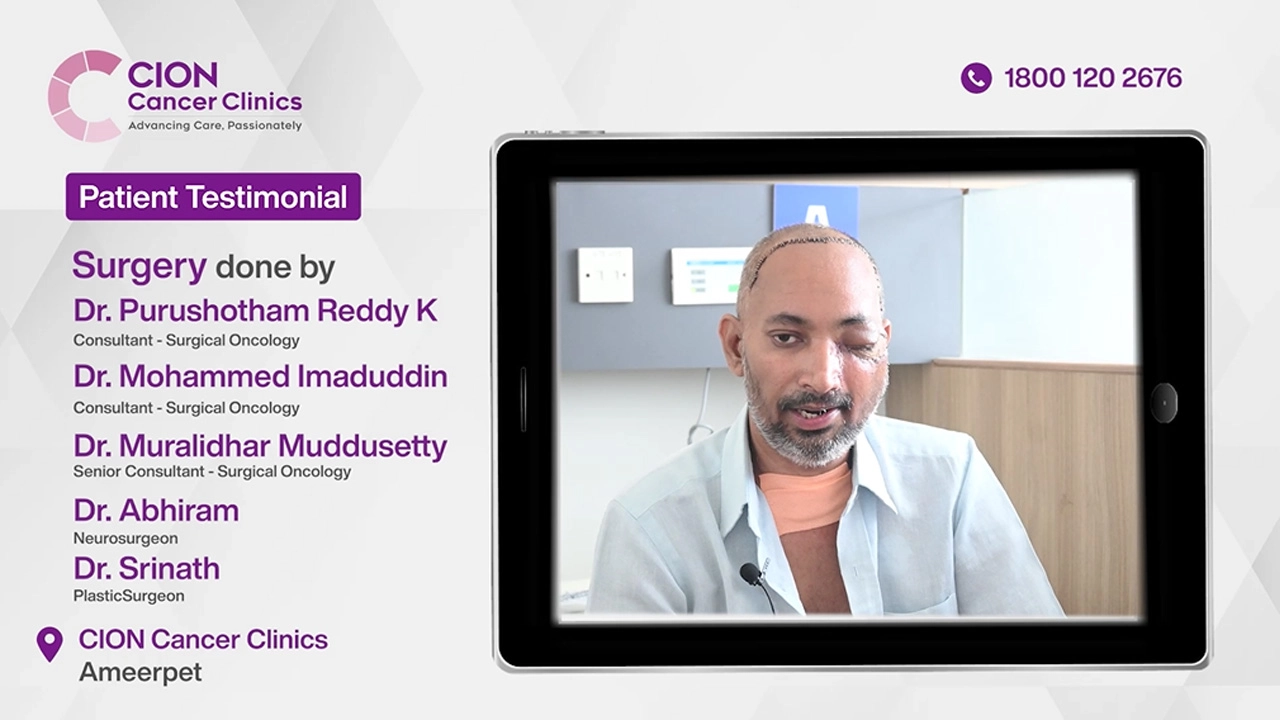
These aren't paid endorsements or written reviews. These are video testimonials from real patients and families — recorded on their own phones, in their own words. Pick any one. Watch it. Then decide.
Read all 800+ reviews on Google
Start Your Story. Book Free Consultation.The most common first sign is persistent bone pain that is not explained by injury. Early bone cancer pain is often described as a dull, deep ache that gradually worsens over weeks, is unrelieved by rest, and frequently wakes the person at night. A new swelling or lump over a bone, or a bone that breaks with minimal trauma, are other important early signs. In teenagers and young adults, persistent bone pain near the knee or shoulder is particularly important to investigate.
Yes — most primary bone cancers are curable today, especially when caught at an early stage. Modern protocols combining chemotherapy with limb-sparing surgery cure 60–75% of patients with localised osteosarcoma or Ewing sarcoma. Chondrosarcoma cure rates with surgery are also high. Outcomes for advanced or metastatic primary bone cancer are more challenging but continue to improve with newer chemotherapy and targeted therapy. Secondary bone tumours are not usually curable but can be controlled for many years with modern systemic therapy.
Primary bone cancer starts in the bone itself — osteosarcoma, Ewing sarcoma and chondrosarcoma are the most common types. Secondary or metastatic bone tumours are cancers that started somewhere else (most commonly breast, lung, prostate, kidney or thyroid) and spread to the bone. Secondary bone tumours are far more common than primary bone cancers and are treated very differently — primarily with therapy aimed at the original cancer, plus radiation and bone-strengthening medication.
Teenagers and young adults are at highest risk for osteosarcoma and Ewing sarcoma. Adults over 40 are at higher risk for chondrosarcoma. Specific risk factors include previous radiation or chemotherapy, inherited syndromes such as Li-Fraumeni or hereditary retinoblastoma, Paget's disease of bone in older adults, and pre-existing benign bone tumours in some cases. People with cancer elsewhere are at risk of secondary bone tumours.
In most cases, no. Modern bone cancer treatment has shifted decisively toward limb-sparing surgery, in which the affected portion of bone is removed and replaced with a modular endoprosthesis (an artificial bone segment) or a bone graft. Amputation is reserved for cancers that cannot be safely removed by limb-sparing surgery — typically large tumours that involve major blood vessels or nerves. The right surgical decision is always made by a specialist sarcoma tumour board, individualised to each patient's tumour, age, and functional needs.
Disclaimer: This page is intended for general informational purposes only and does not constitute medical advice, diagnosis, or treatment. Always consult a qualified oncologist for guidance specific to your medical condition. Content on this page is periodically reviewed and updated by CION's medical team in accordance with current clinical guidelines.