

 CION Ameerpet
Nasal (nasal cavity & paranasal sinus) cancer is rare — and its early signs are easily mistaken for sinusitis. The clue is symptoms that are persistent and one-sided: a blocked nostril, repeated nosebleeds or facial changes that don't clear. Learn the signs, the occupational risks, how it's diagnosed and treated, and what it may cost, so you can act sooner with the right team.
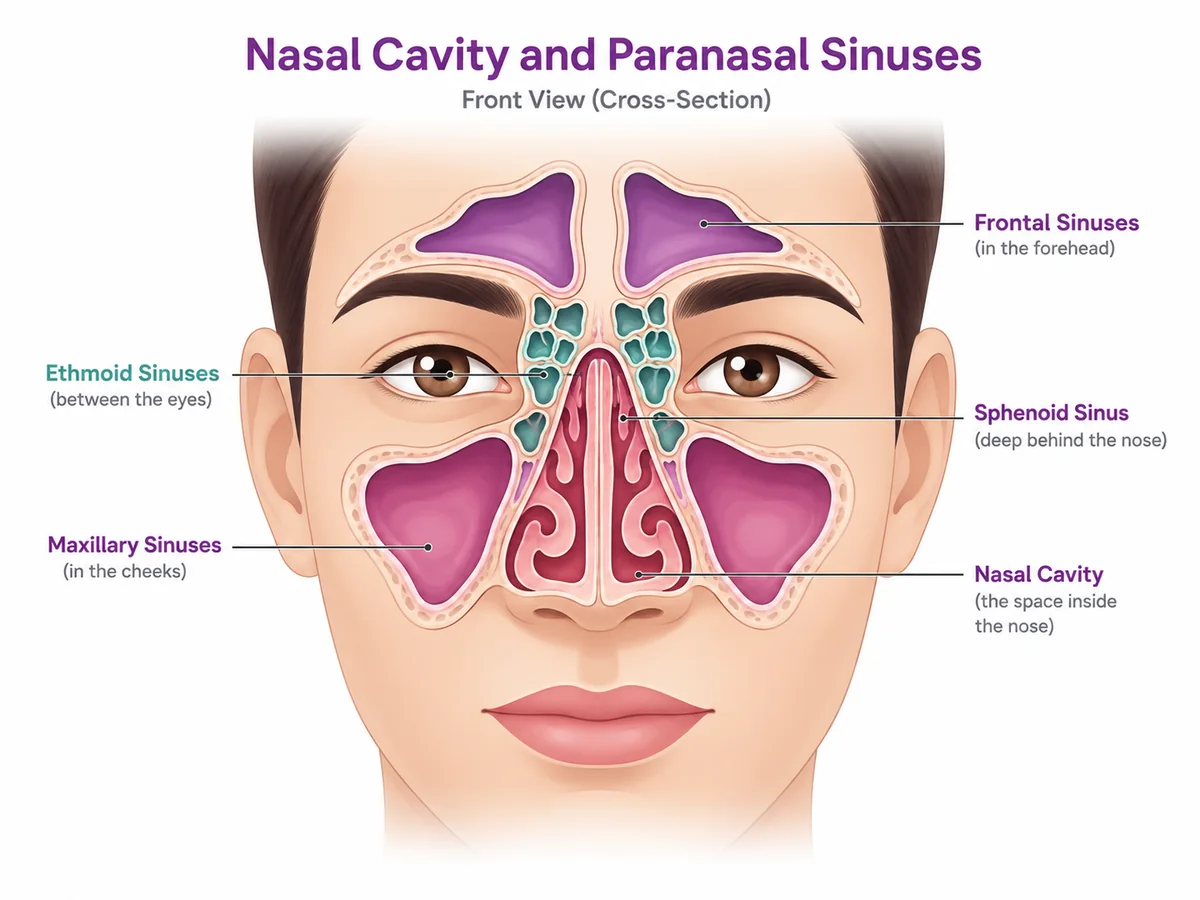
The sinuses are hollow spaces in the cheeks (maxillary), between the eyes (ethmoid), in the forehead (frontal) and deep behind the nose (sphenoid). Cancer here is often found late because early signs feel like an ordinary sinus problem — which is exactly why acting on persistent one-sided symptoms matters.
Tick anything that applies. This is an awareness guide, not a diagnosis — most symptoms turn out to be ordinary sinusitis.
This tool doesn't diagnose nasal cancer or replace a medical opinion. Persistent, one-sided nasal symptoms should be checked — a nasal endoscopy gives clarity. Please consult a CION specialist.
Not every symptom means cancer — but a one-sided pattern that lasts is worth a specialist check. If in doubt, our team can review your symptoms and arrange a nasal endoscopy or scan.
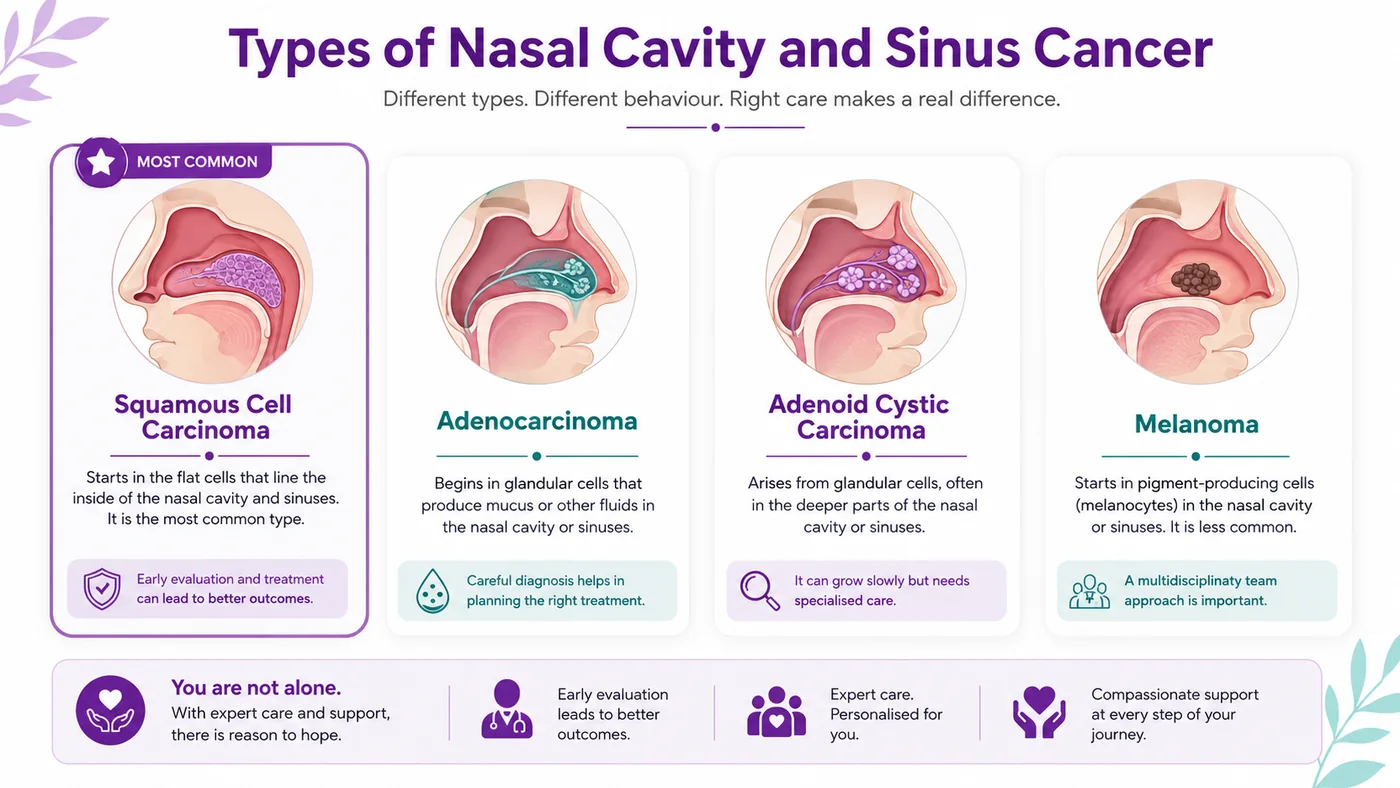
Simplified for understanding. Your exact type, stage and plan are confirmed by your oncology team after tests.
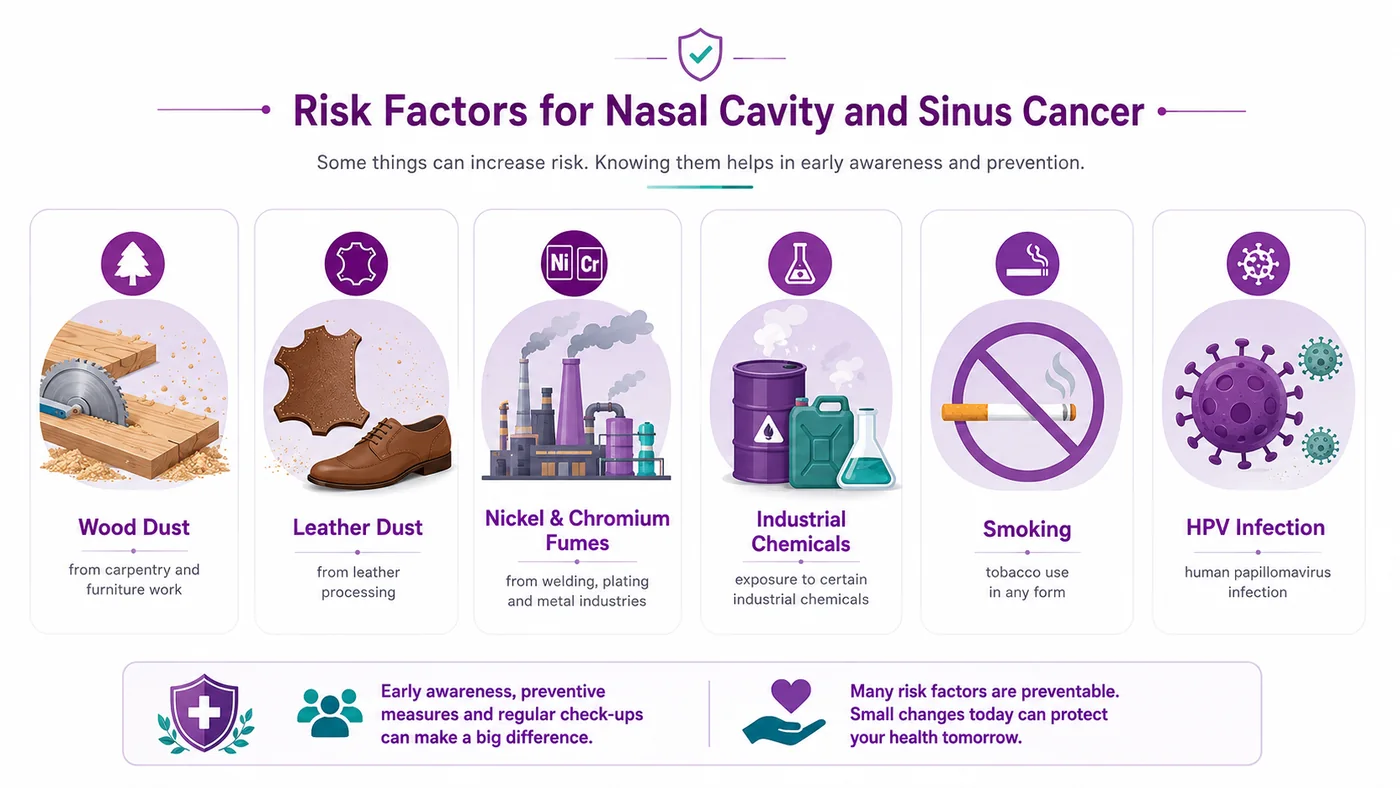
This isn't about blame — many exposures were part of a job done for years. Awareness matters most: workers in wood, furniture, leather and metal trades benefit from acting early on one-sided nasal symptoms rather than waiting.
Limited to the nasal cavity or a single sinus, without spread. Often treated with surgery — increasingly minimally invasive — sometimes followed by radiation, with better outcomes.
Involving nearby bone, the eye socket or skull base, lymph nodes, or distant organs. Managed by the full team with a combination of surgery, radiation and chemotherapy or targeted therapy.
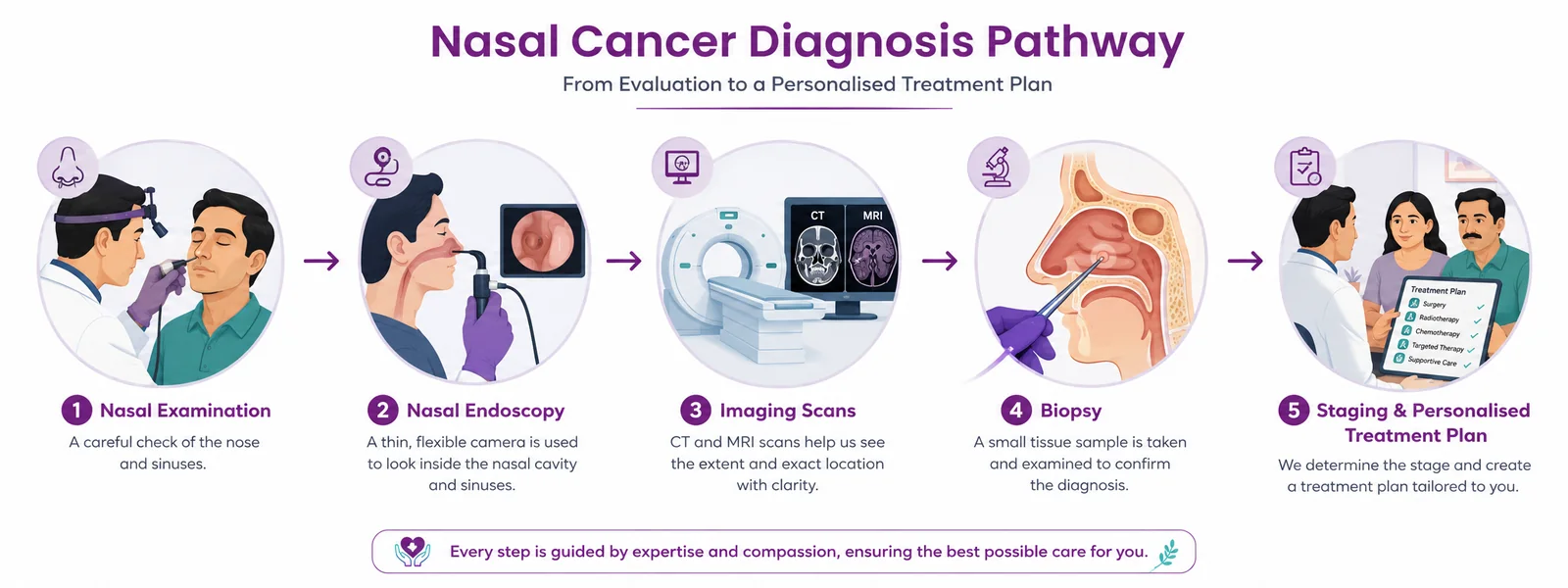
Diagnostic services we offer — book any of these directly:
A thin camera passed gently into the nose to see the nasal cavity and sinuses directly.
A small tissue sample to confirm the diagnosis and the exact type — the only way to be certain.
Detailed imaging of the sinuses and facial bones to map the tumour and plan surgery.
Soft-tissue imaging to see how close the tumour is to the eye socket and skull base.
Whole-body imaging to check for spread and stage the cancer accurately.
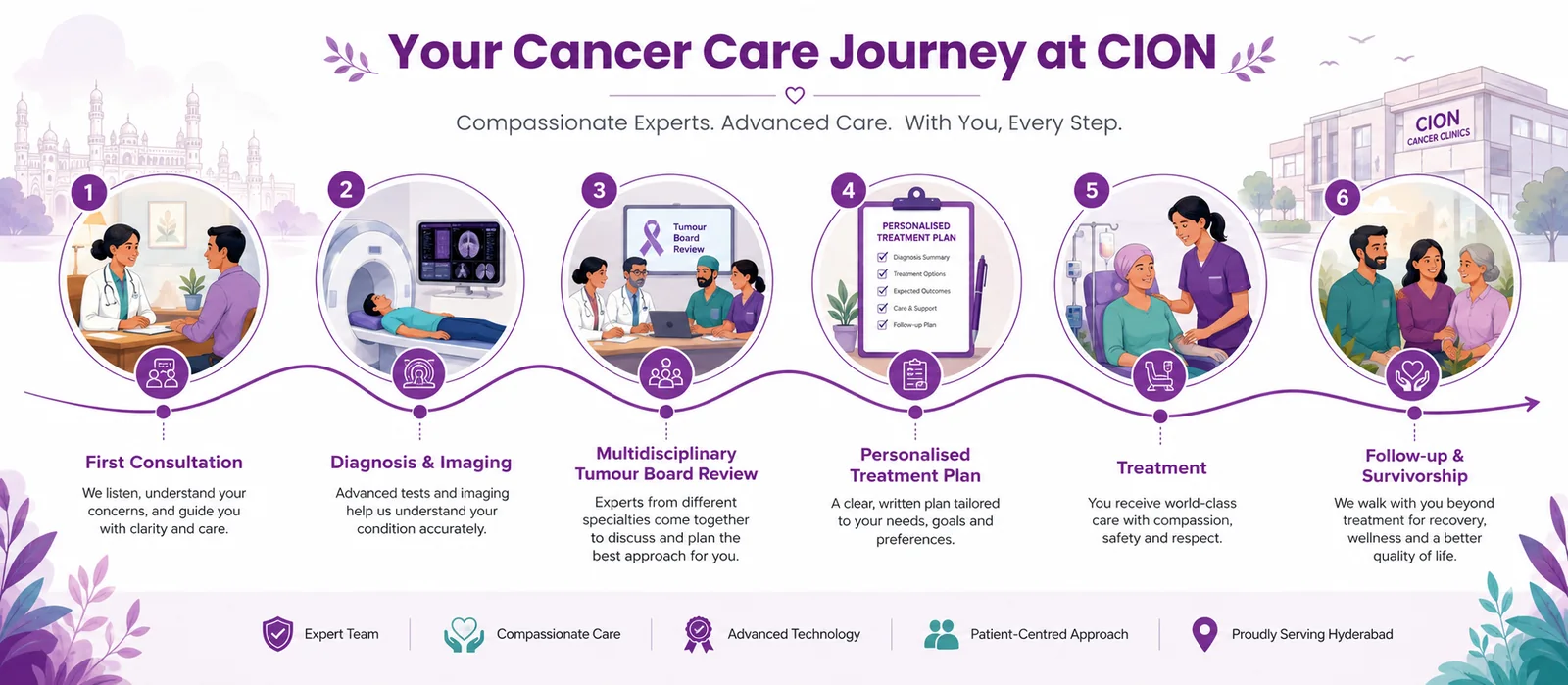
Your scans and biopsy reviewed together by surgical, medical & radiation oncologists.
After examination and endoscopy, CT/MRI and a biopsy confirm the diagnosis; a PET-CT may be used for staging. More on how cancer is diagnosed.
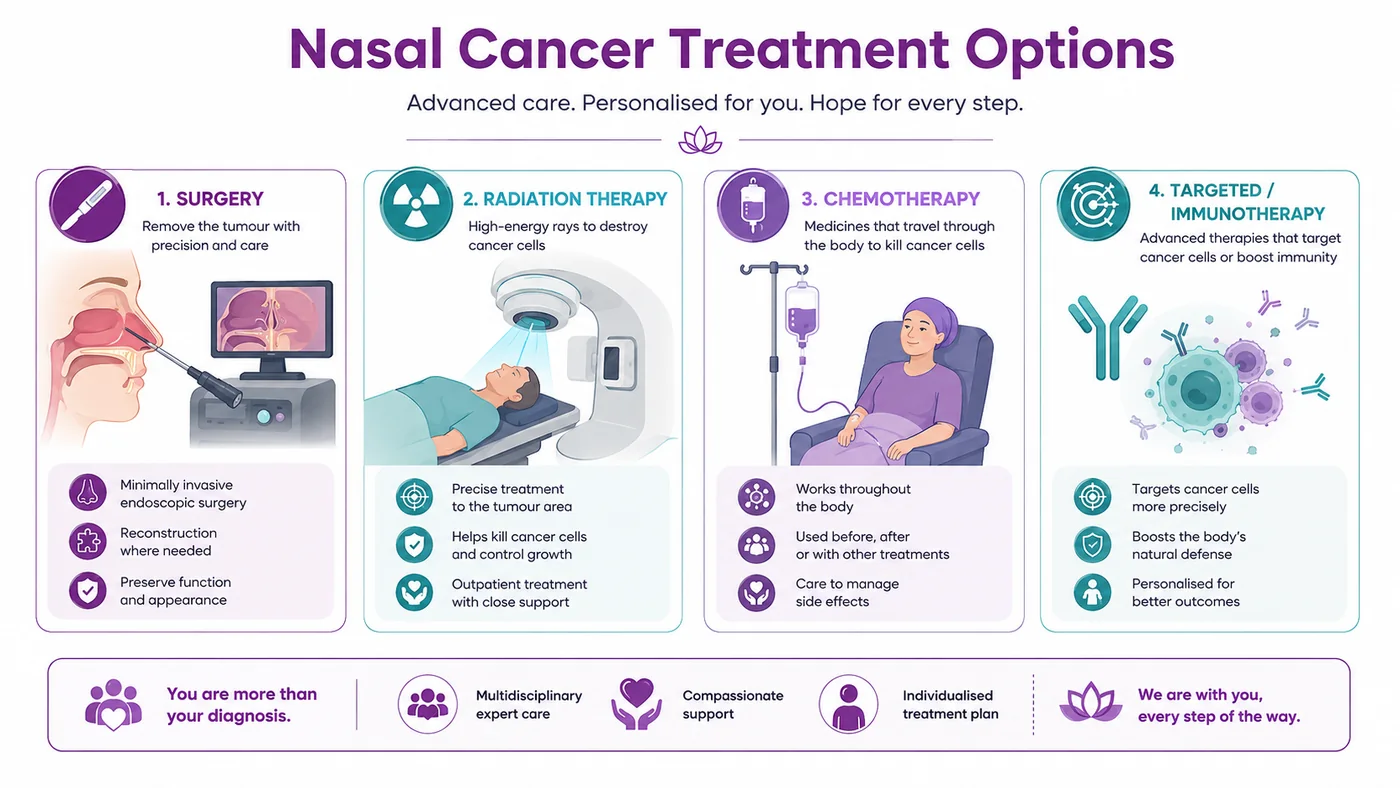
Treatments we deliver — book a consult for any of these:
Removing the tumour — often endoscopically through the nostril — with reconstruction where needed to protect appearance and function.
Precisely targeted IMRT/IGRT radiation — after surgery, or the main option for deep tumours. Aarogyasri-covered.
Medicines that treat cancer throughout the body, given with radiation or for advanced disease.
Newer options for selected advanced cases, decided by the multidisciplinary team.
Chemotherapy and radiation combined — an option where surgery is difficult or to shrink a tumour first.
A clear, unhurried review of your diagnosis, type and options by our head & neck team.
Figures are indicative only and not a quotation. For an accurate estimate, request a callback.

A one-sided blocked nose, a repeated nosebleed or a CT/biopsy report shouldn't wait. Book a free consultation and, if you already have a biopsy, a free written second opinion.
Cost should not delay treatment. Under Aarogyasri and PMJAY, eligible nasal cancer treatment — including radiation therapy — may be largely covered at empanelled centres. Our team helps check eligibility and guides you on insurance and EMI.
We're never more than 30 minutes away. Same panel of specialists at every centre. Same tumour board reviews. Same NCCN protocols. Pick the closest one and call directly — or let us pick for you.
CION Ameerpet
 CION Kukatpally
 CION L.B. Nagar
 CION Tolichowki
 CION Masab Tank
 CION Banjara Hills
 CION Kompally
CION Balanagar
CION Siddipet
CION Sangareddy
CION Kompally
CION Balanagar
CION Siddipet
CION Sangareddy
Not sure which centre fits best? Tell us where you are — we'll suggest the closest one with the right specialists.
Help me pick the right centreTravelling for treatment? We may have a centre right where you are.
Don't see your city? Call 18002028726 — we'll find your nearest CION partner centre.
Surgical, medical and radiation oncologists — with ENT / skull-base collaboration — plan every case together in a multidisciplinary tumour board, part of 17 senior specialists across CION.


MBBS(Gold Medal), DNB(General Medicine), DM(Medical Oncology)(Gold Medal)

MBBS, MD(General Medicine), DM(Medical Oncology)(Adyar,Chennai), ECMO, MRCP SCE(UK)

MBBS, MD (General Medicine), DrNB (Medical Oncology), ECMO, MRCP SCE (Medical Oncology) (UK)


MBBS (AIIMS), MS (Surgery) (AIIMS), DNB (Surgical Oncology), MRCS (Edinburgh)


MBBS, MS(General Surgery), M.Ch(Surgical Oncology), FMAS, FARIS(Ongoing)




MBBS, MS (General Surgery), DrNB (Surgical Oncology), FALS Oncology

Want a specific doctor for your case? Mention them when booking.
Book Free ConsultationShare your name and number — we'll call you back within 30 minutes to schedule your consultation.
Most turn out to be ordinary sinusitis — and if it's more, finding it early changes everything. Our head & neck oncologists can review your symptoms and arrange the right test.
The worries we hear most about nasal cancer, and the facts.
CION treats cancer and only cancer — focused, patient-specific care, not a general hospital's approach.
Surgical, radiation and medical oncologists — with ENT / skull-base collaboration — plan every case in a tumour board.
We take persistent one-sided nasal symptoms seriously rather than dismissing them as sinusitis.
Indicative costs up front, Aarogyasri and PMJAY support including radiation, help with insurance and EMI.
Treatment is delivered within NABH-accredited facilities and their safety and quality standards.
9 clinics across Hyderabad and 35+ centres across Telangana & AP, so care and follow-up stay convenient.
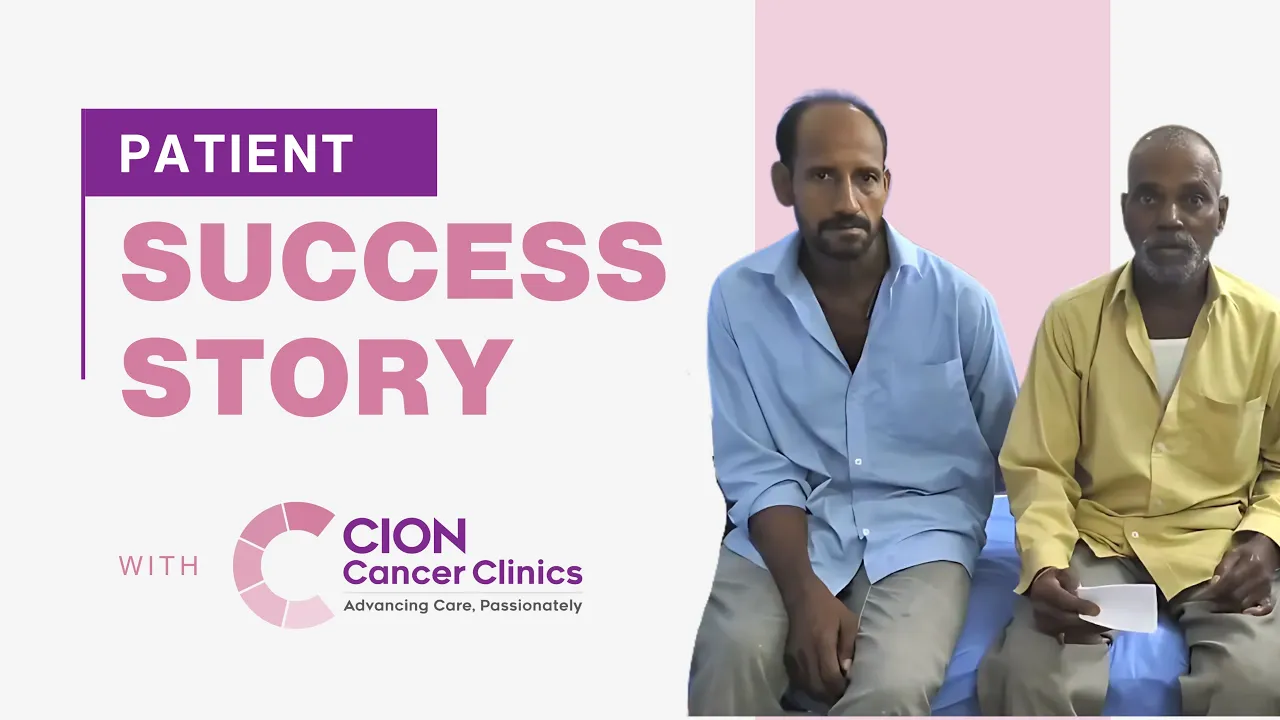
These aren't paid endorsements or written reviews. These are video testimonials from real patients and families — recorded on their own phones, in their own words. Pick any one. Watch it. Then decide.
Read all 800+ reviews on Google
Start Your Story. Book Free Consultation.Nasal cancer can affect breathing, smell, eating and appearance — support around treatment is built into your care.
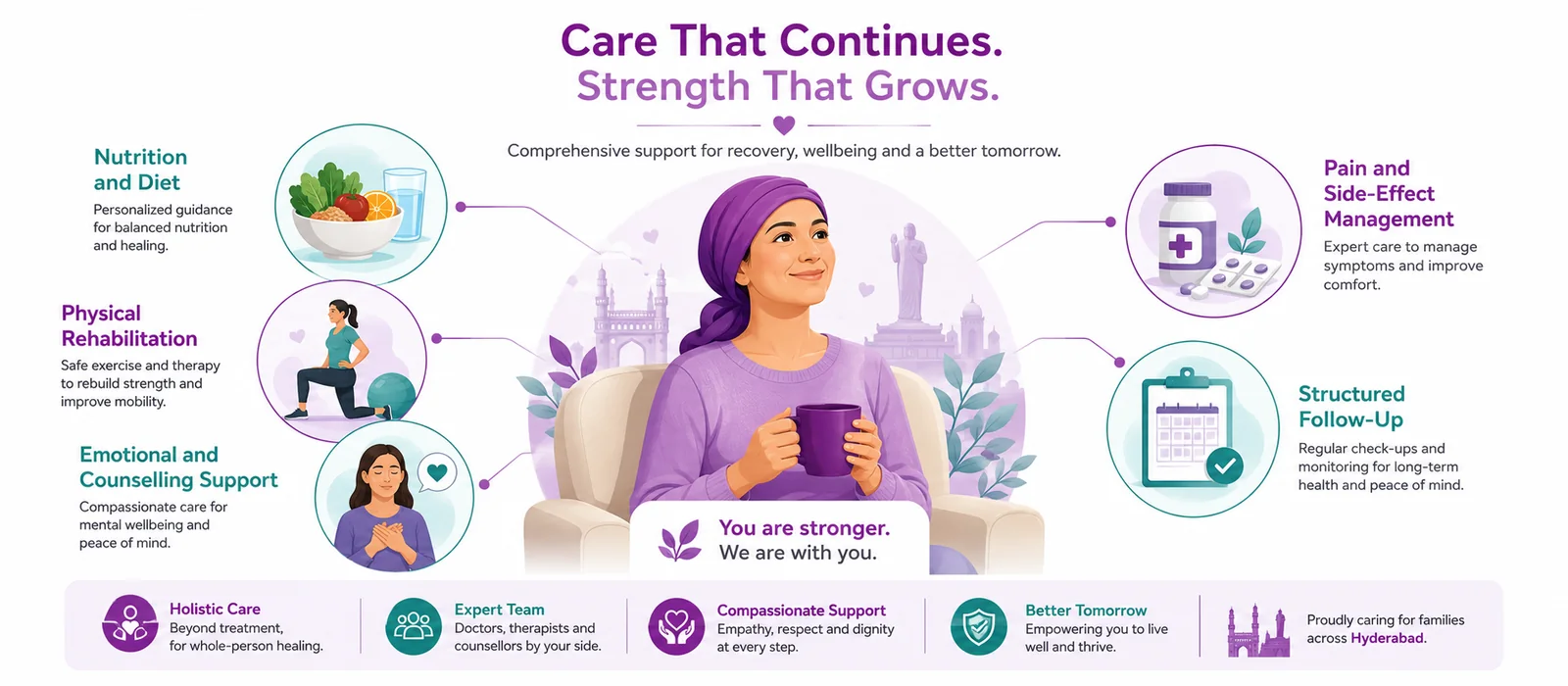
Keeping strength and weight when eating is affected during treatment. Learn more
Emotional support for appearance and confidence — for you and your family. Learn more
Therapy to support breathing, speech and safe swallowing after treatment. Learn more
Comfort and symptom control at any stage, alongside active treatment. Learn more
Structured review after treatment to watch for recurrence and support recovery. Talk to us
A clear, unhurried review of your diagnosis and options. Get a second opinion
Nasal (nasal cavity and paranasal sinus) cancer is uncommon and varies by type and stage. Found early and confined to the nasal cavity or a single sinus, it is often treatable, usually with surgery and radiation. Because early symptoms mimic sinusitis it is often found late, so acting on persistent one-sided symptoms matters most. Your outlook depends on the exact type and stage, which your oncology team explains after tests.
Usually not — most nasal blockage is caused by sinusitis, allergy or a deviated septum. But a blockage or bleeding that is persistent, one-sided and not improving deserves a specialist check, because that one-sided pattern is what raises concern. A quick nasal endoscopy can tell you what is going on.
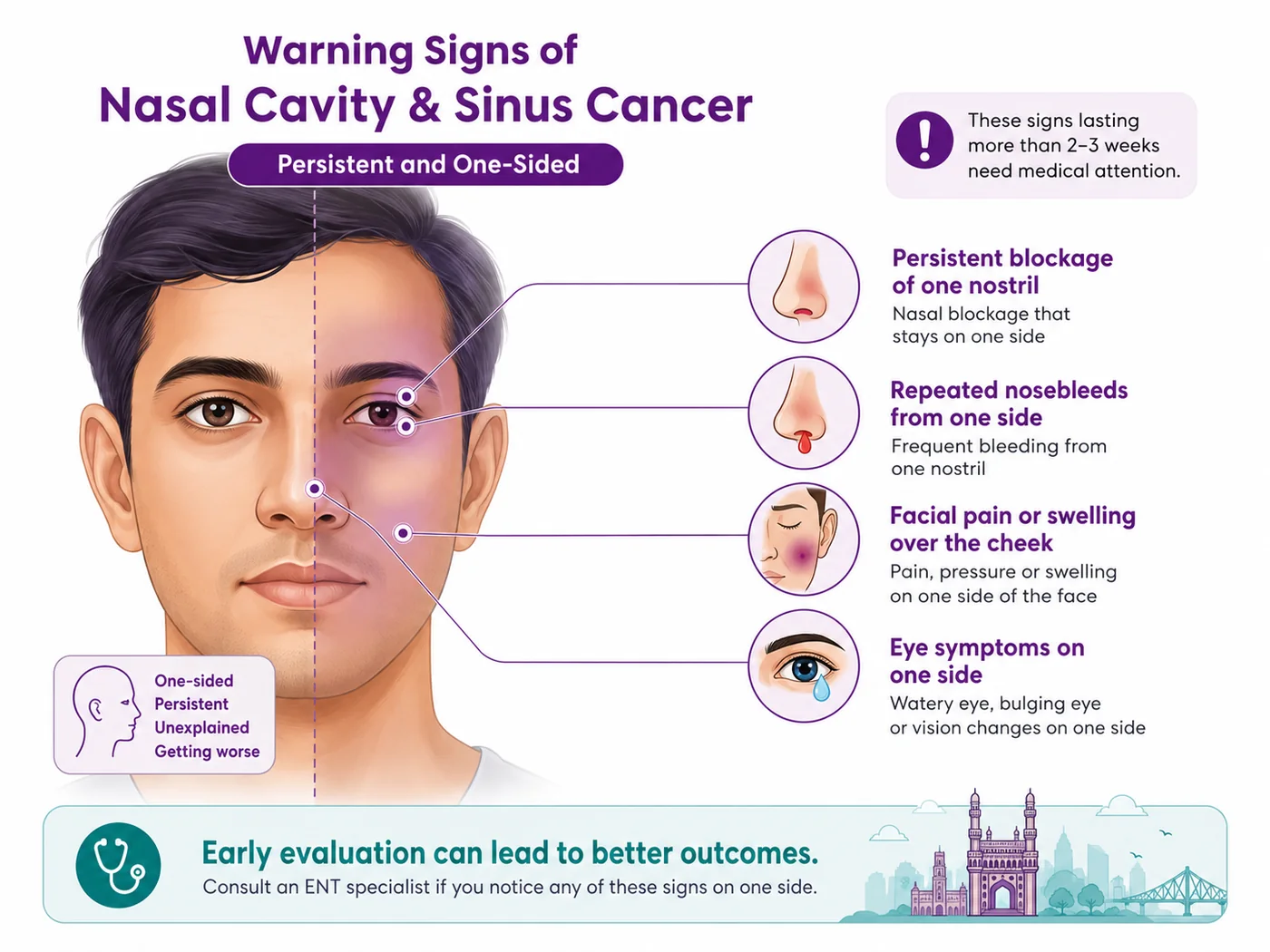
Ordinary sinusitis usually affects both sides of the nose and settles with treatment. Nasal cancer more often causes persistent, one-sided symptoms — a blocked nostril, repeated nosebleeds, facial swelling or eye changes — that do not clear. When in doubt, a nasal endoscopy and, if needed, a scan give the answer.
The warning pattern is persistent and one-sided: a blocked nostril that will not clear, repeated nosebleeds from the same side, facial pain, pressure or swelling, a reduced or lost sense of smell, eye symptoms such as watering, bulging or double vision, or a lump on the face or neck and loose upper teeth. Any of these lasting beyond two to three weeks should be checked.
Yes. Long-term exposure to wood dust (carpentry and furniture work), leather dust, nickel and chromium and certain industrial chemicals is an established risk for nasal and sinus cancer. If you have worked with these materials and have persistent one-sided nasal symptoms, it is worth getting them checked — this is why awareness matters most for wood, furniture, leather and metal trades.
Alongside occupational wood and leather dust, nickel, chromium and industrial chemicals, other risk factors include smoking and infection with human papillomavirus (HPV). Many of these risks are avoidable, and having a risk factor does not mean you will get nasal cancer — but it is a reason to act promptly on persistent one-sided symptoms.
Several types exist, and the type shapes treatment. Squamous cell carcinoma is the most common, arising in the flat cells lining the nasal cavity and sinuses. Others include adenocarcinoma (from mucus-producing glandular cells), adenoid cystic carcinoma (which tends to grow slowly but needs long-term specialised care) and mucosal melanoma (from pigment-producing cells). Your exact type is confirmed by biopsy.
Diagnosis centres on a nasal endoscopy — a thin camera passed gently into the nose so the specialist can see the nasal cavity and sinuses directly. Imaging with CT and MRI shows how far it extends and how close it is to the eye socket and skull base, and a biopsy (a small tissue sample) confirms the diagnosis and type. A PET-CT may be used to check for spread and to stage the cancer.
No. A biopsy is a safe, standard step performed under controlled conditions and does not spread cancer. It is the only way to be sure whether an abnormal area is cancer and, if so, which type — which is essential for planning the right treatment. The real danger is delay, not the biopsy.
A nasal endoscopy is an outpatient test in which a thin, flexible camera is passed into the nostril to look directly inside the nasal cavity and sinuses. It is usually done after a numbing spray and is generally quick and well tolerated, with only mild discomfort. It gives the specialist a clear view that examination alone cannot.
Surgery is usually the main treatment and is increasingly done endoscopically through the nostril, often followed by radiation therapy. For deep tumours where surgery is difficult, radiation may be the main option, and chemotherapy or targeted therapy is added for advanced disease. The plan is decided by a multidisciplinary head and neck team based on your type and stage.
Endoscopic sinonasal surgery removes the tumour through the nostril using a camera and fine instruments, with no external facial incision in many cases. It is an established, specialised technique that can fully remove many nasal and sinus tumours with less disruption than open surgery, and reconstruction is used where needed to protect appearance and function.
Modern nasal cancer surgery is often minimally invasive and is planned to preserve appearance and function wherever possible. Many people keep normal breathing and their sense of smell. Where more extensive surgery is needed near the eye or skull base, reconstruction and rehabilitation help protect and restore function, and your surgeon explains exactly what to expect for your case.
Cost depends on the type, stage, the surgery and whether radiation or chemotherapy is needed, so it is best given as an indicative range after assessment. Eligible treatment, including radiation therapy, may be covered under Aarogyasri or PMJAY at empanelled centres, and we help with insurance and EMI. Use the estimator on this page for an indicative figure, then request a callback for an accurate estimate.
Yes, for eligible patients. Under Aarogyasri and PMJAY, eligible nasal cancer treatment — including radiation therapy — may be largely covered at empanelled centres. Our team helps you check eligibility and complete the paperwork, and guides you on private insurance and EMI options if a scheme does not apply.
No. Standard external-beam radiotherapy does not make you radioactive, and you can safely be around family, including children. Your radiation oncologist will clearly explain any exception before treatment begins. Radiation for nasal cancer is precisely targeted to protect nearby structures such as the eyes.
Because the nasal cavity and sinuses sit close to the eye sockets and the base of the skull, advanced nasal cancer can extend towards these structures — which is why accurate imaging and staging matter. Treatment planned by a head and neck team aims to control the cancer while protecting the eyes and surrounding structures as much as possible.
It varies by type, stage and plan. Surgery may involve a short hospital stay plus recovery, while a course of radiation typically runs over several weeks, and combined treatment can take a few months in total. Your team gives you a personalised timeline once the type, stage and plan are confirmed.
It can, which is why structured follow-up matters. Regular reviews after treatment watch for any recurrence so it can be caught and treated early. Attending your follow-up appointments and reporting any new or returning one-sided nasal symptoms promptly gives the best chance of catching a recurrence early.
For a blocked nostril, repeated one-sided nosebleeds or facial changes that have not cleared in two to three weeks, see a head and neck cancer specialist (surgical oncologist), often working with an ENT specialist for the endoscopy. At CION your case is reviewed by a team — surgical, medical and radiation oncologists together — so you get a coordinated plan rather than a single-doctor decision.
Our guide to nasal & sinus cancer — treatment, doctors, diagnosis, cost and support. Tap any topic to read more.
Most turn out to be ordinary sinusitis — and if it's more, finding it early changes everything. Book a free consultation or second opinion at any of our 9 Hyderabad clinics, part of 35+ centres across Telangana & Andhra Pradesh.